














Legalization of documents
issued in the UAE for
use in another country:
from 5 days and 250 USD
 We certify all types of documents issued in the UAE for individuals and legal entities.
 Over 1,000 successfully completed projects for consular legalization and document apostille.
Therefore, all documents requiring official authentication must undergo a full legalization process. This includes attestation by the UAE Ministry of Foreign Affairs and the embassy or consulate of the country where the document will be used (if issued in the Emirates), or by the embassy/consulate of the document’s country of origin for use in the UAE.

In the UAE, the following documents can be legalized for individuals:
- Birth certificates.
- Marriage certificates.
- Divorce certificates.
- Death certificates.
- Educational documents: Diplomas, transcripts, and certificates confirming education and qualifications.
- Police clearance certificates.
- Medical certificates.
In the UAE, the following documents can be legalized for legal entities:
- Certificate of initial approval.
- Certificate of company name reservation.
- Lease agreement registered in the government system.
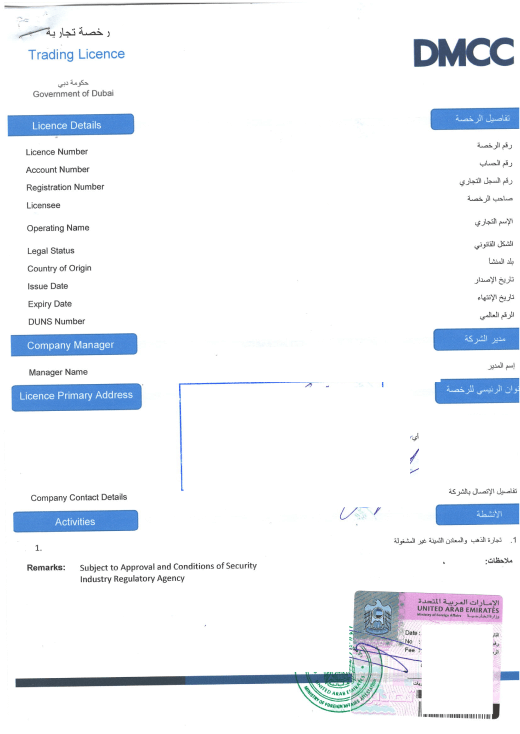
- Business license.
- Commercial registry extract.
- Memorandum of Association (MOA).
- Certificate of registration with the Chamber of Commerce.
- Establishment Card.
- Tax registration certificate.
- Company liquidation certificate.
- Board of Directors resolutions.
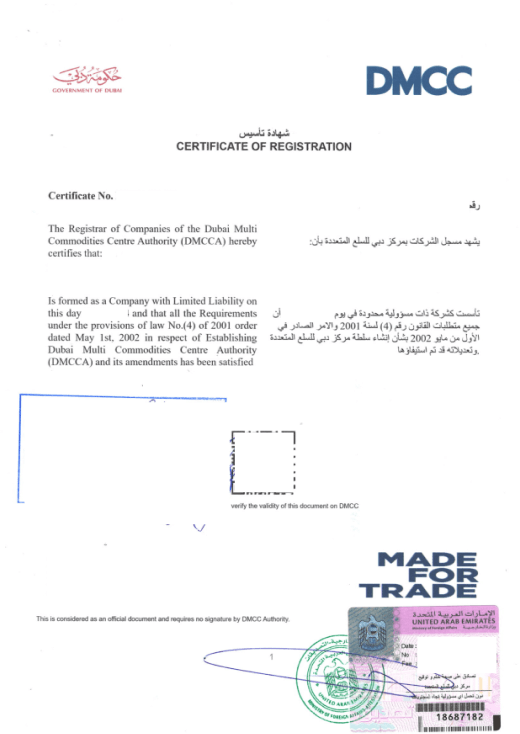
- Documents issued by free zones.
- Audit reports.
- Contracts concluded in the UAE.
- Customs documents.




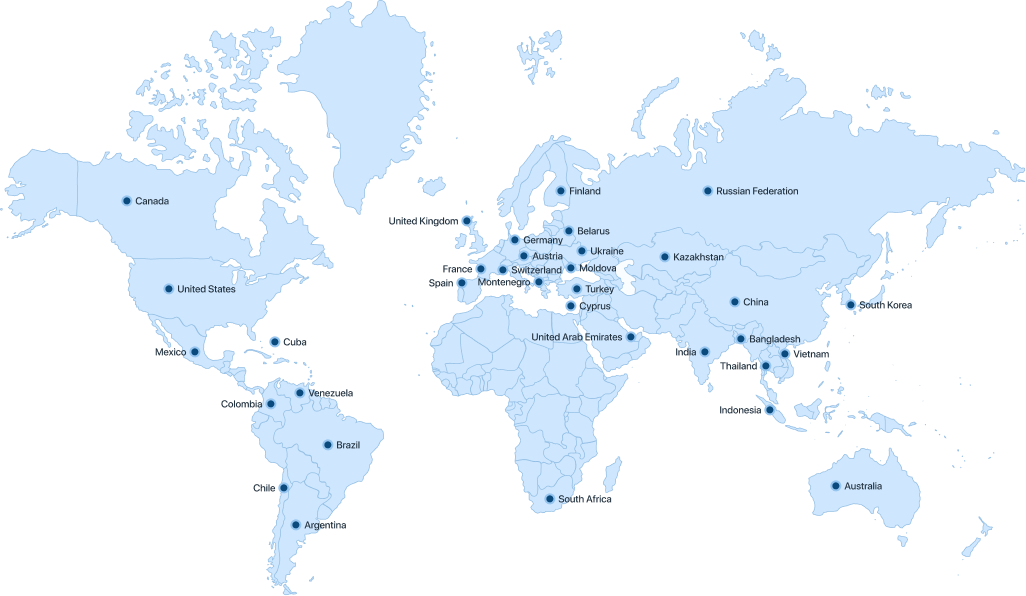
No matter where you are in the world, we make registering your business easy and efficient. Our clients are located in: India, Pakistan, China, the United Kingdom, France, Spain, the United States, Switzerland, Austria, Finland, Germany, Mexico, Australia, Thailand, Cyprus, Vietnam, Bangladesh, South Korea, Indonesia, Montenegro, Argentina, Chile, Brazil, South Africa, Canada, Kazakhstan, Russia, Moldova, and Turkey.
Frequently Asked Questions
Document legalization is the official process that validates documents issued in one country so they are legally recognized in another. In the UAE—where business, residency, education, and legal matters frequently involve international parties—legalization is essential to give foreign documents legal standing. This applies to corporate charters, academic diplomas, birth or marriage certificates, and more, ensuring they are accepted by government entities, banks, schools, and courts.
Corporate documents: Articles of incorporation, commercial licenses, certificates of good standing (e.g., for opening bank accounts or registering branches)
Personal documents: Birth certificates, marriage certificates, police clearance letters (for visas, residency, or employment)
Academic credentials: Degrees, transcripts, or diplomas (for job applications, further studies, or professional licensing)
The UAE is not a signatory to the 1961 Hague Apostille Convention. As a result, an apostille is not sufficient for use in the UAE. Instead, documents must undergo full consular legalization—a multi-step verification process that begins in the issuing country and concludes with UAE authorities.
- Document preparation: Gather original documents or notarized copies.
- Authentication in the country of origin: Typically requires certification by a notary, then the Ministry of Foreign Affairs (or equivalent).
- Consular legalization: Submit the documents to the UAE embassy or consulate in the issuing country for verification.
- Final attestation: Complete the process with the UAE Ministry of Foreign Affairs (MOFA).
- Certified translation (if needed): Documents not in Arabic or English must be translated by an approved translator and the translation legalized alongside the original.
The exact sequence may vary depending on the document type and country of origin.
- Start early: The full process can take 5 days to 4+ weeks, depending on the country and document complexity.
- Budget accordingly: Fees vary by document type, country, and urgency—some steps may require separate payments.
- Verify requirements in advance: Contact the relevant UAE embassy or end-user authority (e.g., a free zone, school, or bank) to confirm their specific document standards.
- Avoid common pitfalls: Incomplete forms, unsigned documents, or unverified translations are frequent causes of rejection.