
















What is the proven formula for guaranteed success when registering or relocating your business to the UAE?
First, determine your business activity, select the emirate where you wish to operate, and choose the appropriate registration zone (e.g., mainland, free zone, or offshore) within that emirate. Next, obtain the relevant business license, change your visa status accordingly, and apply for an Emirates ID. After that, open corporate and personal bank accounts—and, most importantly, ensure ongoing compliance with the laws, regulations, and cultural norms of the United Arab Emirates while operating your business.
“I want to launch a business abroad, but I can’t decide on the right country—and I’m worried I’m unaware of many crucial factors needed to organize the process correctly. So what should I do?”
We have the answer to this question. For many entrepreneurs and investors, establishing a company in the UAE is a highly promising option for scaling business internationally.
In this article, we outline the key aspects of company registration in the United Arab Emirates to help you enter this dynamic market confidently and avoid common pitfalls.
Why the UAE Is an Excellent Choice for Business
In a world where every minute determines who leads and who follows, the United Arab Emirates offers not just “another jurisdiction,” but a fully operational, launch-ready ecosystem—complete with infrastructure, trust, and opportunities built in by default.
And here’s why it works—specifically for you:
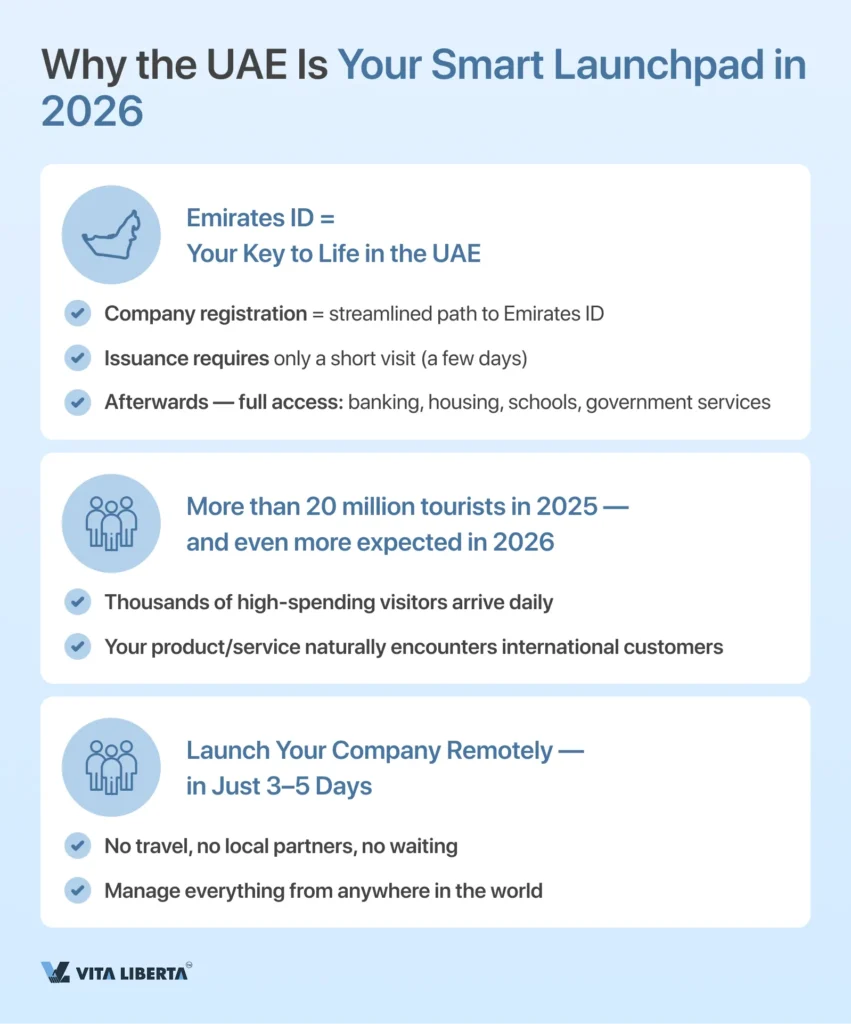
First: Your Emirates ID begins with a business decision.
Registering a company in the UAE grants you the right to a streamlined Emirates ID application process—free from bureaucratic labyrinths and multi-stage approvals. Yes, a brief in-person visit to the country (just a few days) is required for biometric registration, but the entire process is pre-arranged: documents are prepared, visas are pre-approved, and appointments at service centres are booked in advance. Once you receive your Emirates ID, you gain full access to life in the Emirates: corporate and personal banking, property rental, healthcare, schools for your children – all unlocked by a single plastic card.
Second: Your first client is already en route.
In 2025, the UAE welcomed approximately 20 million tourists. In 2026, this figure is expected to grow further—driven by new flight routes, event-based tourism, and the country’s global reputation as a safe and attractive destination. Imagine: every day, thousands of people with open minds and strong purchasing power arrive at the airports of Dubai and Abu Dhabi. Your product, service, or digital solution can find its customer even before you launch your first marketing campaign—simply because you are here, at the epicentre of global movement.
Third: You can get started without ever leaving your desk. The entire company registration process is conducted remotely—from selecting the jurisdiction and company name to receiving an electronic business license. Everything is completed within 3–5 business days, with no need for personal presence or local intermediaries. You can manage the process from Berlin, Tokyo, or Lima—while your company is already legally established within one of the world’s most dynamic economies. And when you decide to transition from remote management to on-the-ground operations—we’ll prepare everything for your first visit: visa, formal invitation, and a scheduled appointment for Emirates ID enrolment.
Fourth: You’re not simply entering a market—you’re joining a community.
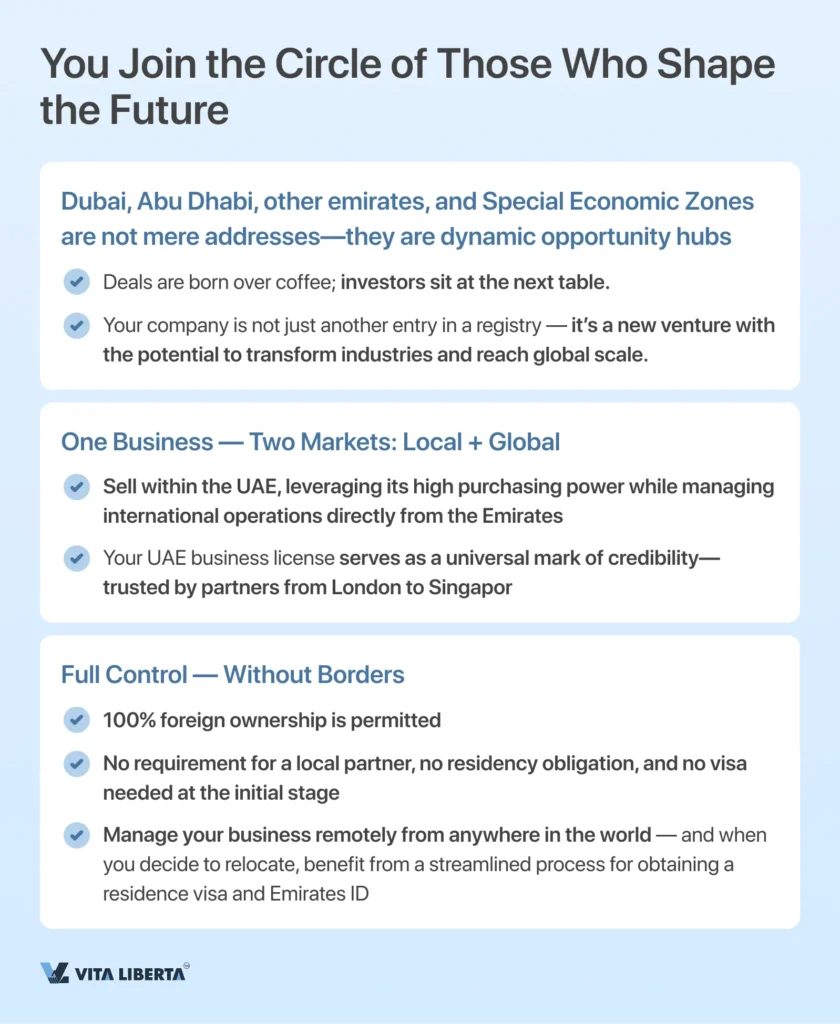
Dubai, Abu Dhabi, and the UAE’s free zones are not mere geographical locations; they function as social and intellectual accelerators. Here, million-dollar deals are discussed over breakfast, and the person sitting next to you in a co-working space could become your first investor. In the Emirates, opportunity density is measured not in square metres, but in the number of conversations that reshape a business’s trajectory. Your company is not “just another license”—it’s a new voice within a community shaping tomorrow.
Fifth: Your business gains dual citizenship—local and global.
The UAE is a rare jurisdiction where you can simultaneously offer premium services to affluent Dubai residents and use the same entity as an international headquarters for operations across Europe, Asia, or Africa. Thanks to the jurisdiction’s spotless reputation, your UAE license functions as a mark of quality—partners in London, Zurich, or Jakarta trust you faster than you might expect.
Sixth: Borders fade—but control remains firmly in your hands. Any foreign national may hold 100% ownership and serve as sole director—without a local partner, without residency, and without needing a visa at the outset. Manage your business from Paris, Bangkok, or Mexico City—while your company lives, operates, and grows in the UAE. And when you’re ready to relocate? We ensure a seamless transition: residence visa processing, Emirates ID issuance, and on-the-ground support—all positioned as a natural continuation of your initial decision, not a new puzzle to solve.
UAE Taxation: A Strategic Advantage, Not a Loophole
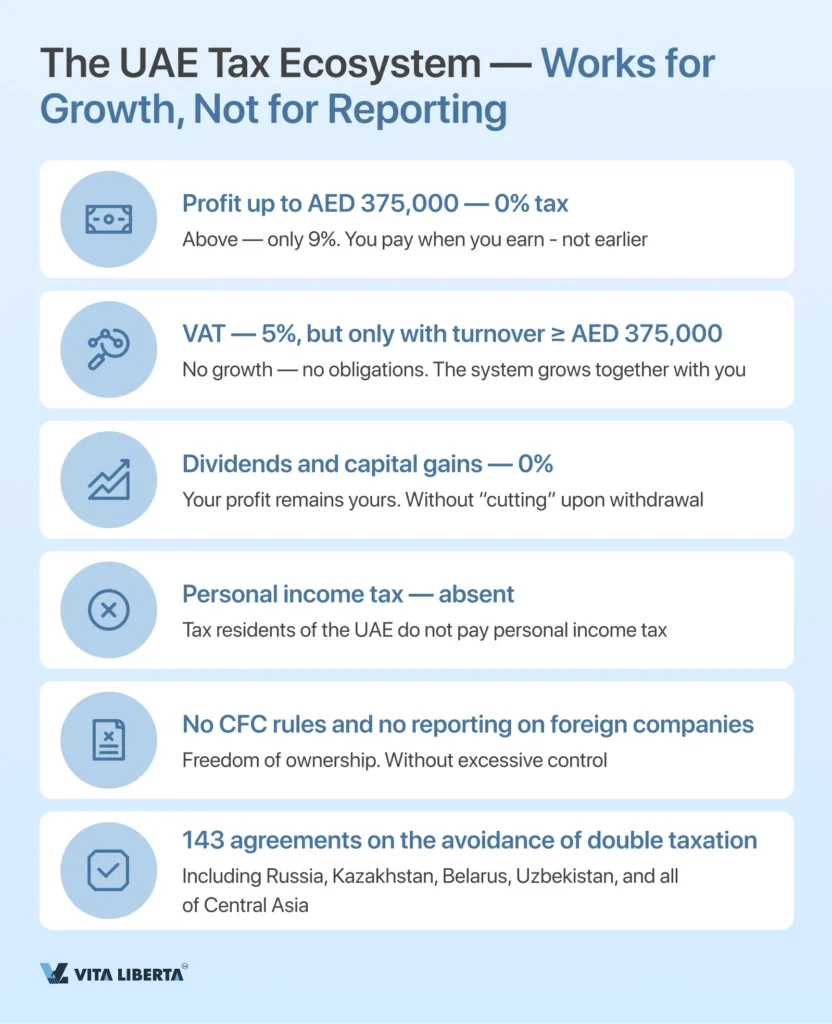
In the UAE, taxes are not overlooked — they are deliberately designed to foster business growth rather than mere survival. Here is how it works in practice:
Profits up to AED 375,000 are entirely exempt from taxation.
Above the threshold—just 9%. This is not merely a “low rate.” It is precisely calibrated economic stimulation: you pay tax only after you have achieved profitability. Small and medium-sized enterprises gain genuine operational breathing room—free from artificial fiscal pressure during their critical early stages.
VAT — 5%, but only with turnover from AED 375,000.
There is no need to register with the tax authority if you have not yet reached this threshold. This is flexibility, not formality: you scale — the system adapts to you, not vice versa.
Not a penny — on dividends. Not a penny — on capital gains.
Owners receive profit in full, investors — exit without tax “cutting”. In a world where every percent decides, the UAE leaves money where it should be — in the real motivation of the entrepreneur.
Personal income tax? No!
Tax residents of the UAE do not pay personal income tax and are not required to declare ownership of foreign structures.
CFC rules for tax residents of the UAE? Also no.
Legislation on controlled foreign companies (CFC) does not exist in the country. This is not an omission — this is a deliberate choice in favour of capturing new markets.
143 agreements on the avoidance of double taxation — including all of Central Asia and the CIS.
Russia, Kazakhstan, Belarus, Uzbekistan, Kyrgyzstan, Tajikistan, Turkmenistan — all key jurisdictions are covered. This means: your structure in the UAE does not create additional tax burden at home. On the contrary — it becomes a tool for optimisation, recognised at the international level.
The UAE does not offer “zero taxes” — it offers a rational tax ecosystem, where every rule works for growth, not for burden.
That is precisely why those who come here are not those who want to “hide”, but those who are ready to build — openly, at scale, and for the long term.
The UAE: More Than Easy—Intelligently Built
The United Arab Emirates do not attract investors with promises. They build conditions in which success becomes the natural consequence of the right decision.
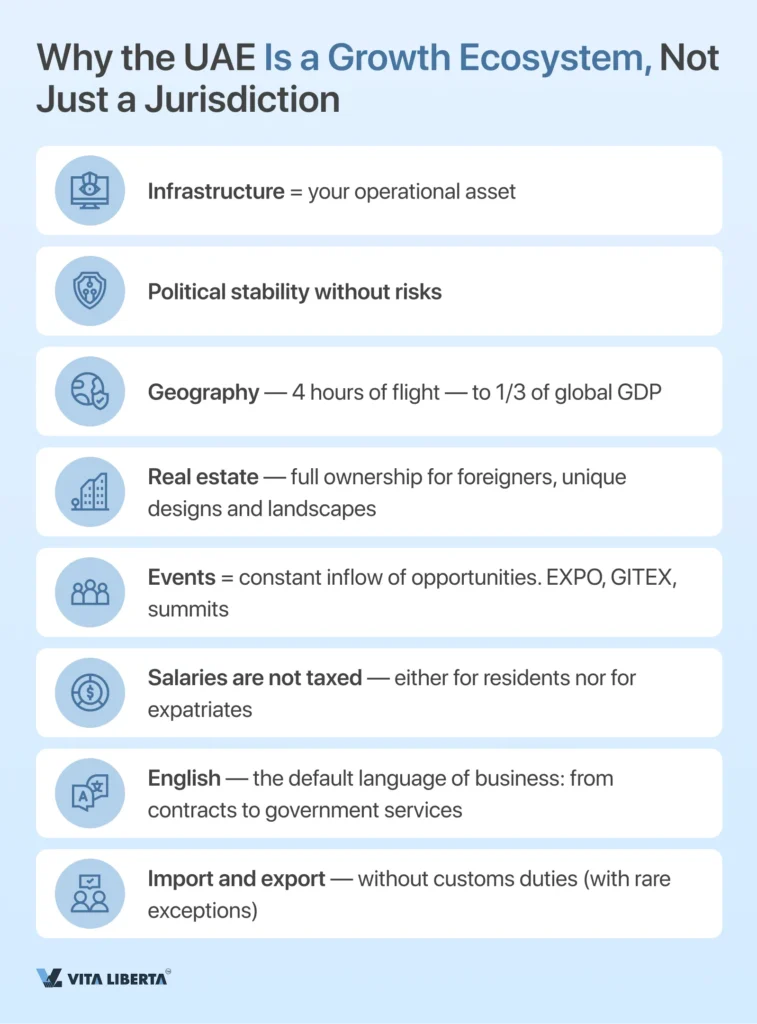
Infrastructure — as an investment in your success
The state invests billions not in “beautiful buildings”, but in functional power: hub airports, logistics corridors, digital government services, next-generation energy systems. All of this is not a backdrop — it is your operational asset from day one.
Policy without risks — for business without borders
Neutrality, predictability, openness to dialogue. In a world where geopolitics can nullify a strategy within a week, the UAE remains an island of stability and trust — without ideology, but with clear rules.
Geography as an advantage
A 4-hour flight — to one-third of global GDP.
The UAE are located at the centre between Europe, Asia, and Africa — not metaphorically, but in real time zones and air corridors. Your warehouse, office, or headquarters here is not a location. It is a point of optimal coverage.
Real estate — not an asset, but a platform
Stable demand, transparent laws, the possibility of full ownership (including for foreigners) — all this makes real estate in the UAE not just an investment, but the foundation for management, hosting, service, and even educational business models.
Events — as a constant impulse
From EXPO and GITEX to global summits and sporting events — the Emirates annually gather millions of decision-making moments. Your business here is not an observer, but a participant at the epicentre of demand, innovation, and connections.
Team without a tax barrier
Employees’ salaries are not subject to personal income tax — either for residents nor for expatriates. This means you can assemble a world-class international team without hidden costs and tax compromises.
English — the default language of business
Although the official language is Arabic, English is used everywhere: in courts, banks, government services, schools, contracts. No interpreters, duplicate documents, or language barriers — only speed and clarity.
Trade without duties — as the norm
No import or export duties (with rare exceptions). Your goods enter and exit freely — as in a global free trade zone with legal protection and logistical speed.
The UAE do not offer “conveniences”.
They create an ecosystem where every element — from geography to the tax code — works for your scale.
That is precisely why those who come here are not those seeking shelter, but those ready to build openly, grow confidently, and operate globally.
Types of Companies in the UAE
The UAE is not a single jurisdiction, but a multi-layered business ecosystem. The choice of company type determines not only where you can operate, but also what access you gain to the market, visas, clients, and growth opportunities. Everything starts with three models — each with its own logic.
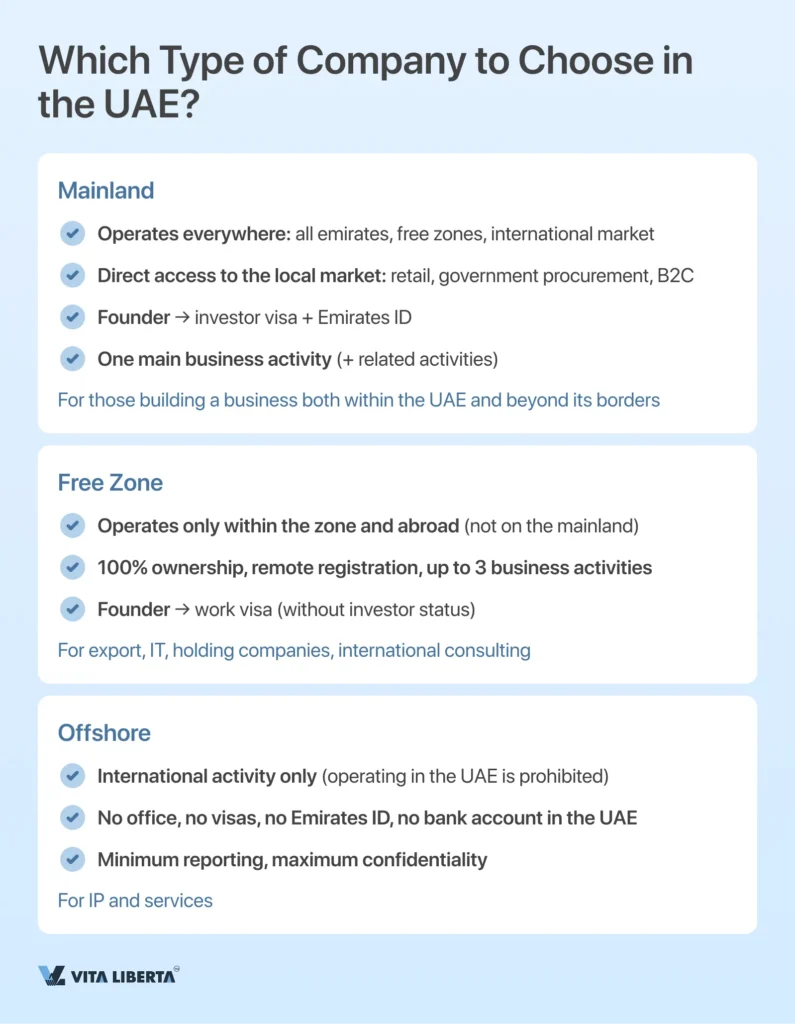
1. Mainland — full access to the UAE market
The company is registered on the “mainland” territory of one of the seven emirates (most often — Dubai or Abu Dhabi).
- Right to operate everywhere: across all emirates, in free zones, and beyond the country’s borders.
- Direct access to the local market: government procurement, B2C, retail, services to individuals.
- Visa status: founders obtain an investor/partner residence visa + Emirates ID. Employees receive work visas.
- It is possible to engage in one business activity.
For those building a business both across the entire UAE territory (including free zones) and internationally beyond the UAE.
2. Free Zone — an autonomous business ecosystem
More than 50 free zones across the country (20 in Dubai alone), each with its own specialisation: from technology to logistics and media.
- 100% foreign ownership, simplified registration, remote management.
- Restriction: business activity is allowed only within the zone and outside the UAE. Operating on the “mainland” is prohibited, except through third parties.
- Possibility to select up to three different business activities.
Visas: founders and employees receive work visas, but not investor visas (though this may vary from zone to zone).
For whom: exporters, IT companies, holding companies, consulting firms — those serving the international market rather than the local one.
3. Offshore — a legal instrument without physical presence
Registered in specialised offshore jurisdictions (e.g., RAK ICC, JAFZA Offshore).
- Full anonymity, minimal requirements, zero taxes.
- No visas, no Emirates ID, no physical office required.
- Any commercial activity within the UAE is strictly prohibited.
For whom: intellectual property holding, investment structuring — not for operational business, possibly for service provision.
Geography Matters
The UAE is a federation of seven emirates:
- Abu Dhabi — the capital, centre of politics and oil capital (2.5+ million people).
- Dubai — the business heart, hub for global business (3.3+ million people, 20+ free zones).
- Other emirates (Sharjah, Ras Al Khaimah, Ajman, etc.) — niche jurisdictions with specific conditions and cost structures.
The key rules:
Not “which company to open”, but “which strategy you intend to implement”.
- Mainland — for full local and international presence.
- Free Zone — for international presence and operations within free zones.
- Offshore — for international activity only.
Choosing the Right Location for Registration
This is not a question of cost — it is a question of alignment with your business model!
Choosing between mainland (government territory) and free zone is not a technical decision. It is a strategic act that determines your geography, client base, team, and even how banks perceive you. Here is what truly matters:
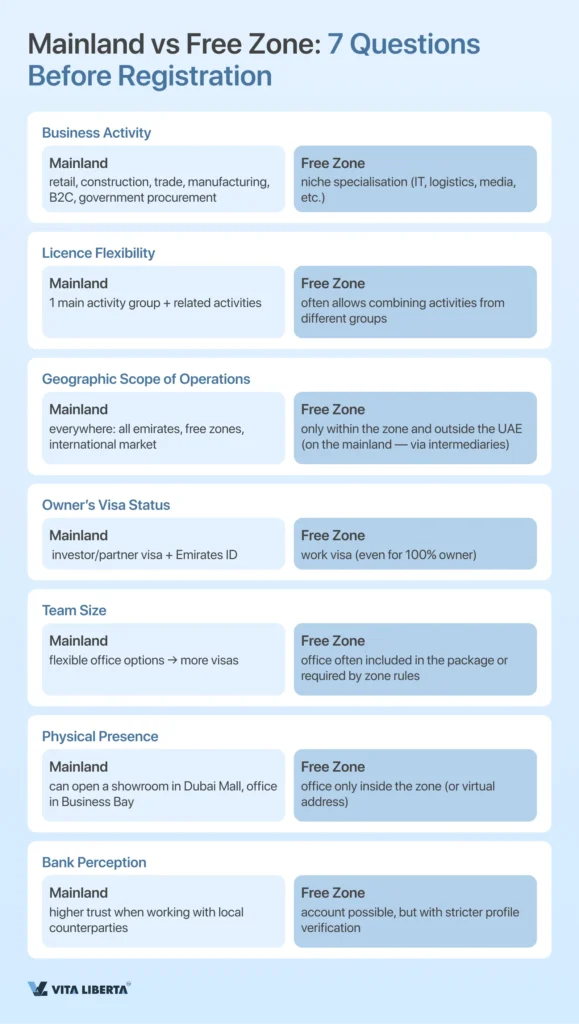
1. Business activity — not just a code, but a key to opportunities
Mainland offers the widest possible catalogue of licences through the Department of Economic Development (DED), including retail, construction, education, and services to individuals. However, certain sectors (medicine, finance, legal services) require additional approvals or a local partner.
Free zones, by contrast, are specialised: IT in DIFC, logistics in JAFZA, and so on. Here you receive not just a licence, but an ecosystem — but only within the zone’s designated scope.
2. Flexibility of business model: one licence — multiple activities?
On the mainland, you select one primary activity group and may add only closely related activities within that group. Want to combine, for example, consulting and software sales? Possibly — but with restrictions.
In many free zones, flexibility is higher: you can combine activities from different groups (e.g., educational services + IT development), provided they fit the zone’s profile.
3. Where you can operate determines whom you can serve
A mainland company has the right to conduct business anywhere: across all emirates, in free zones, and internationally. This is the only route to direct engagement with the local market — from government tenders to retail customers.
A free zone company is restricted from operating on the mainland. Its clients are either within the zone or abroad. This is not a drawback — it is focus. Operations on the mainland are possible only through intermediaries.
4. Visa status: investor or employee?
Only on the mainland does the founder receive an investor/partner residence visa — with the right to reside, open bank accounts, and sponsor family members.
In free zones — even a 100% owner receives a work visa tied to the company. This is a subtle but important distinction: one status signals “I am building the business myself”, the other — “my company is part of a larger free zone investor ecosystem”.
5. Team scale depends on physical space
The number of visas is directly linked to office size. On the mainland — a vast selection of premises: from virtual addresses to offices in Business Bay or other districts. This provides hiring flexibility.
Free zones often require office rental within the zone and may impose specific conditions or offer limited options. However, most free zones include a registered address in their package, meaning you may not need to lease a physical office.
6. Physical Presence: Where Must Your Office Be?
Если ваш клиент — в центре Дубая, а шоурум — в Dubai Mall, то только mainland даёт право открыть точку на этом адресе.
Если же вы управляете бизнесом удалённо или обслуживаете международных клиентов — free zone может быть дешевле, проще и быстрее.
7. Bank Account: Not All Structures Are Treated Equally
UAE banks tend to place greater trust in mainland companies — especially when dealing with local counterparties. This is not a rule, but a trend.
Free zone entities can also open accounts but often require a more detailed profile: source of capital, owner’s experience, transparency of the supply chain. The more complex the model, the higher the requirements.
Conclusion
A well-informed choice of registration location is business design backwards:
— Who is your client?
— Where do you meet them?
— What team are you building?
— What status do you need — operational or instrumental?
The answers to these questions will show not where your company can merely “be registered”, but where it will truly grow.
Three Common Myths About Company Registration in the UAE
The UAE is often perceived through the lens of oversimplifications: “zero taxes”, “100% ownership everywhere”, “offshore without rules”. In reality, the situation is different. Here is what you truly need to know to avoid mistakes from the outset.
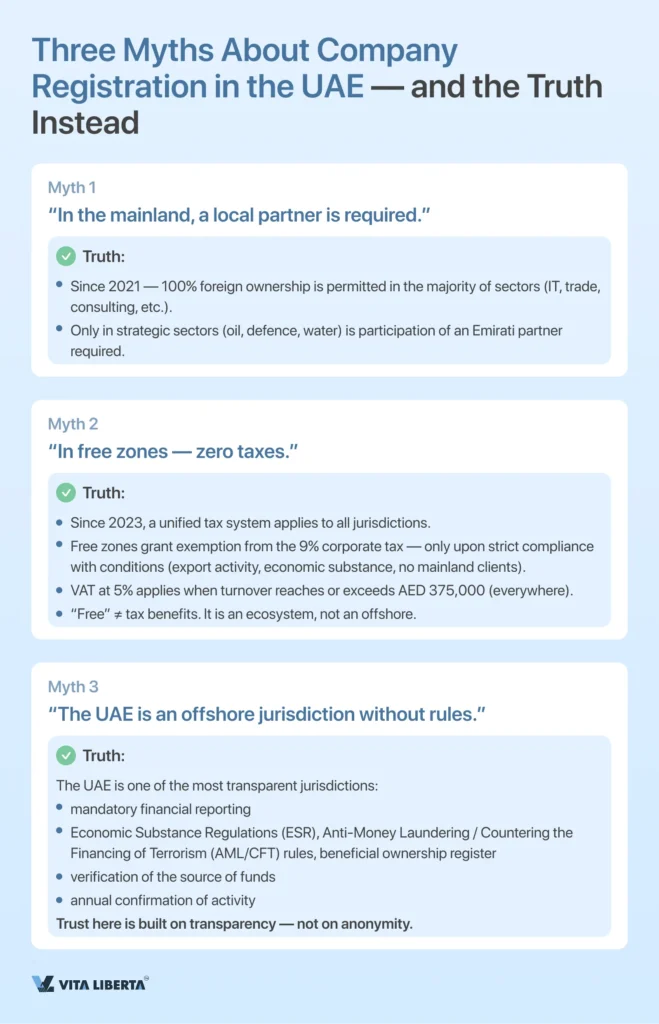
Myth №1: “A local partner is mandatory for mainland companies”
Reality: Since 2021, foreigners may own 100% of a mainland company—without a sponsor, without a nominee shareholder, and without hidden schemes.
This applies to the vast majority of sectors: IT, consulting, trade, construction, education, and others.
Exception: strategic sectors—oil, gas, defence industry, water supply, and certain types of telecommunications. In these cases, participation of an Emirati partner (often via government holdings) is still required.
Conclusion: do not rely on outdated guides. Today, mainland means full control + full market access.
Myth №2: “There are no taxes in free zones—at all”
Reality: Since 2023, the UAE has implemented a unified corporate tax system applicable to all jurisdictions—including free zones.
Yes, companies with “qualifying income” may be exempt from the 9% corporate tax, but only if:
- their income comes exclusively from “qualifying activities” (e.g., export of services outside the UAE);
- they do not conduct business with mainland residents;
- they maintain “adequate economic substance” (office, employees, expenses within the zone);
- they pass the annual assessment to obtain the status of a “Qualifying Free Zone Person” (QFZP).
If even one condition is violated—tax is applied to all profit exceeding AED 375,000.
In addition, VAT at 5% applies once turnover reaches or exceeds AED 375,000—regardless of jurisdiction.
Conclusion: a free zone is not a “tax loophole” within the UAE; rather, it is largely an ecosystem within the UAE offering added value through well-designed registration packages and networking opportunities—but not tax preferences. Do not associate “Free” with tax benefits; this is a misconception.
Myth №3: “The UAE is an offshore jurisdiction without rules”
Reality: The UAE is one of the most regulated and transparent jurisdictions in the Middle East.
There are no “black boxes” here. Instead, there are:
- mandatory submission of financial statements;
- Economic Substance Regulations (ESR) requirements;
- AML/CFT (Anti-Money Laundering / Countering the Financing of Terrorism) rules;
- strict scrutiny of the source of funds when opening a bank account;
- mandatory registration in the beneficial ownership register.
Even offshore structures (e.g., in RAK ICC) are subject to annual activity confirmation and licence renewal fees.
And most importantly: the UAE is not an offshore jurisdiction in the classical sense. It is an international financial and trade hub where trust is built on transparency — not anonymity.
Conclusion: the “register and forget” approach does not work here. Success requires respect for the rules—and for yourself as a businessperson.
Final Takeaway
The UAE offers real advantages—but only to those who understand them not as loopholes, but as a system.
Choose your jurisdiction not based on myths, but on your business model, clients, and goals.
Mainland vs. Free Zone Companies: Similarities and Key Differences
| Mainland Company | Free Zone Company |
| Foreigners may own 100% of the company’s share capital. | Foreigners may own 100% of the company’s share capital. |
| A non-resident may serve as the company’s manager. | A non-resident may serve as the company’s manager. |
| It is necessary to calculate and pay corporate tax at a rate of 9% upon exceeding a turnover of 375,000 dirhams. | It is necessary to calculate and pay corporate tax at a rate of 9% upon exceeding a turnover of 375,000 dirhams. There are eligibility criteria that allow exemption from corporate tax; however, meeting these criteria is quite complex and entails significant additional costs without a guaranteed outcome. |
| It is necessary to calculate and pay VAT at a rate of 5% upon exceeding taxable supplies and imports of 375,000 dirhams. | It is necessary to calculate and pay VAT at a rate of 5% upon exceeding taxable supplies and imports of 375,000 dirhams. |
| The law does not require an annual audit. It is recommended for verifying the accuracy of accounting records, as well as for submission to banks, partners, and investors. | Some free zones require companies registered within their territory to undergo an audit. This requirement is also a condition for licence renewal. |
| The choice of business activity is generally comprehensive. | Most free zones are specialised. Some zones offer a broad range of business activities. |
| Within a single company (licence), it is possible to select one main activity group and add activities available only within that group. | Within a single company (licence), it is generally possible to select several activity groups. |
| Business owners may obtain an investor visa (if there is one shareholder) or a partner visa (if there are two or more shareholders), while employees of the company are issued work visas. | Business owners and their employees may obtain only a work visa. |
| Greater flexibility in selecting office premises across all parameters. An office may be leased in any emirate and in any free zone. | Office rental is permitted only within the territory of the free zone. In some cases, with the free zone’s approval, an office may be leased outside its territory. The choice of office premises is limited to what the free zone offers. However, free zones provide virtual office services, which are sufficient for company registration but largely fail to meet the requirements of local banks. |
| The government registration authority is the Ministry of Economy and Tourism. | The registration authority is the free zone itself. |
| High initial registration cost. Subsequent maintenance costs are lower. | Registration cost is comparable. Subsequent maintenance costs may be either lower or higher. |
Step-by-Step Process for Opening a Company in the UAE
Let us consider the steps for opening a company in the UAE.
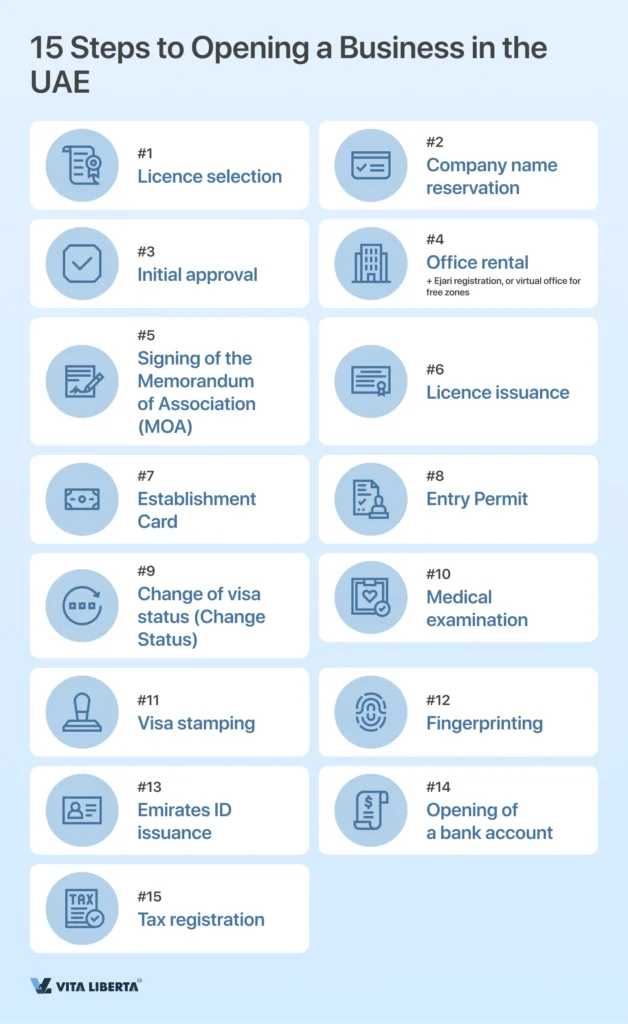
1. Selection of the licence most suitable for your type of activity
In the UAE, a licence is required for each type of business activity—a document granting the right to conduct entrepreneurial activities in the country. Licences can be divided into four main types:
- Commercial (trading) licence. Covers all activities related to trade and sales. Business activities falling under a commercial trading licence in the UAE include import/export, food retail, rental services, brokerage firms, logistics, real estate, and many others.
- Professional licence. Issued for the provision of professional services: accounting, legal, marketing, advertising, software development services, and many others.
- Industrial (manufacturing) licence. Required for the production of any goods. Also includes the sale of manufactured products. Any manufacturing activity implies that goods are produced for sale. A physical office is mandatory.
- Tourism licence. To regulate the tourism sector, the UAE’s Department of Economic Development introduced a tourism licence, which must be obtained by travel agencies, tour operators, and hotels.
In addition to the main types of licences, there are also:
- e-commerce licence;
- freelancer licence;
- cryptocurrency trader licence;
- influencer licence.
Operating a business without a licence is illegal. The licence is issued for one year and must be renewed annually.
2. Reservation of the company name
In the UAE, company names are governed by strict regulations. The company name must not violate the religious values of the state. If you wish to name the company after a person, you must prove that this individual is a partner or owner of the business. The company’s legal form must be indicated in the name. Typically, this is an abbreviation placed at the end of the name—for example, L.L.C. (for limited liability companies on the mainland), FZE (for free zones), etc. This abbreviation reflects not only the type of organisation but also the jurisdiction in which the business is registered. Once the name has been verified and reserved, a corresponding certificate is issued. This is a mandatory step in the company registration process.
3. Initial Approval
This is a document granting permission to establish a legal entity in the UAE with specific parameters:
- legal form of the company;
- type of licence;
- type of economic activity;
- licence parties (partners);
- share allocation.
4. Lease Agreement — Ejari
Ejari is the government portal for the mandatory registration of all lease agreements in the UAE. The system ensures transparency of rental relations for all parties to the lease agreement. The tenant is responsible for registering the agreement in the Ejari system. Typically, the agreement is registered instantly via a dedicated application once the landlord uploads the required documents.
If you choose a mainland company, it generally must have a lease agreement registered in the Ejari system.
Some free zones provide a virtual office upon registration (rental of a desk and chair within the free zone centre, with possible use of telephone services); however, such arrangements are not recorded in the Ejari system.
It is important that the Ejari registration covers a period of at least one year to align with the validity period of the business licence.
5. Preparation and signing of the Articles of Association
The Memorandum of Association (MOA) is the key corporate document signed by the founding members or partners, expressing their consent to the establishment of the company. It is essential that each shareholder consents to the opening of the company in accordance with UAE legislation.
The MOA is drafted in Arabic but may be translated into other languages for convenience. The document must be registered with the commercial register of the Department of Economic Development of the respective emirate or with the authority of the free zone where the company will operate. For example, to open a business in Dubai, interaction with the Department of Economic Development of Dubai is required.
6. Issuance of the activity licence
In the UAE, each type of business activity is licensed separately. The licence grants permission to engage in the specified activity; essentially, it is the fee paid for the right to conduct business in the country. Upon submission of the company name reservation certificate, initial approval, and Ejari registration, the licence is issued after payment of the corresponding government fee.
7. Obtaining the Establishment Card
After receiving the licence, it is necessary to obtain the company’s Establishment Card from the immigration authority. The card confirms that the company is officially registered, and that its employees and owners are eligible to apply for residence visas. Without this card, it is impossible to submit applications for residence visas—for oneself or for employees.
8. Application for an Entry Permit
To obtain a residence visa, a specially formatted entry application—the Entry Permit—is used. With this permit in hand, you may plan your trip to the UAE. This document facilitates entry for foreign nationals into the UAE to complete the residence visa application process. The Entry Permit is valid for 60 days. If, at the time of receiving the Entry Permit, you are already in the UAE, you must apply for a change of visa status in order to complete the residence visa procedure without leaving and re-entering the country. This service is available upon request for an additional fee.
9. Change of Visa Status — Change Status
Change Status is the process of changing the type of visa, allowing one to remain in the country legally. Typically, you enter the country as a tourist, and after establishing the legal entity, you apply for a visa as an investor, partner, or employee. The visa status change procedure enables a swift transition from the current lawful stay status to the new one.
10. Medical Examination
To obtain a visa and the Emirates ID, the applicant is required to undergo a medical examination (blood test and chest X-ray). Upon completion, a medical certificate is issued, confirming that the applicant meets the health standards set by the authorities.
11. Visa stamping
The final step in changing one’s immigration status to resident includes submitting an application for visa stamping in Dubai. To complete this process, the medical certificate obtained through the procedure described above must be submitted in advance.
Currently, a physical visa stamp is no longer placed in the passport; instead, every individual must submit an application for the electronic visa stamp.
The following documents are required for visa stamping in Dubai:
- Copy of the applicant’s passport
- One photograph
- Electronic visa copy
- Application for Emirates ID issuance
- Medical examination result
- Sponsor’s Emirates ID
- Sponsor’s IBAN bank account number
12. Biometric Fingerprinting
To obtain the Emirates ID, it is mandatory to undergo fingerprint registration. This requirement applies to all UAE residents aged 15 and above. After providing fingerprints, the applicant may proceed with submitting the application for the Emirates ID card.
13. Issuance of Emirates ID
The Emirates ID in the UAE is a mandatory identity document for residents and foreign nationals. The plastic card contains a unique identification number, encrypted personal data, and the holder’s fingerprints. To access government services and exercise legal rights, residents must obtain the Emirates ID after receiving their residence visa. This card enables the use of various services—for example, passing through passport control, paying utility bills and fines, connecting internet and telephone services, and registering private vehicles. For UAE citizens, the Emirates ID is issued for 5 or 10 years. For UAE residents, the Emirates ID is valid for the duration of the residence visa—typically 2 years.
Launch Your Business in the UAE in 5 Days – No Bureaucracy, No Risk
- Direct registration through UAE authorities
- Legal tax burden from 0% to 9%
- 100% ownership and investor visa in 7 days
14. Opening a personal account and a corporate account
To ensure the subsequent operation of the company, it is necessary to open a bank account. This is a very important and, arguably, the most challenging stage of starting a business.
Aspects that increase the chances of successfully opening an account with a bank:
- A company registered on the mainland territory of an emirate (a mainland company).
- A maximally clear and comprehensive business presentation—description of goods, services, geographical scope of operations, counterparties, and employees. All information that can be provided about your business should be disclosed.
- Presence of a physical office with Ejari registration.
- Possession of a valid residence visa and Emirates ID by the founder—this is a mandatory requirement.
- Existence of a personal bank account held by the founder in the UAE or another country (in banks not under sanctions). Transparent personal income and substantial account balances generate interest from banks.
- Existence of a similar business in another country, supported by documented evidence and a banking history with a non-sanctioned institution; a bank statement may be provided.
- Ability to maintain a minimum required balance in the UAE bank account. This point is negotiated directly between the client and the bank during the substantive phase of account opening discussions.
When selecting a bank, it is recommended to pay attention to the following points:
- Carefully review the bank’s terms and tariff plans.
- Read reviews from real clients.
- Assess the minimum cost of account opening and maintenance. Clarify which fees will be incurred during operations.
- Inquire about additional services and bonuses.
15. Tax registration
A newly established company must be registered with the tax authority and obtain a Tax Registration Number (TRN).
In 2023, the UAE ceased to be a zero-tax jurisdiction. Corporate tax at a rate of 9% has been applicable since 1 June 2023. For income not exceeding AED 375,000, the tax rate is 0%. Special conditions also apply to companies operating in free zones. Pursuant to Federal Decree-Law No. 47 issued by the Federal Tax Authority (FTA), all companies are required to complete registration in the corporate tax system.
In conclusion, we emphasise that company registration in the UAE is a significant step for entrepreneurs aiming to launch their business in this prosperous country. It is essential to choose the correct registration location, company type, and licence(s); obtain the necessary permits and visas; comply with legislative requirements during establishment and ongoing operations; and fulfil all tax obligations.
FAQ
The UAE is not a “one-size-fits-all solution”. It is a tool for those who wish to grow openly and globally.
If you plan to:
→ work with international clients,
→ gain access to a market with 20+ million tourists per year,
→ manage your business from anywhere in the world,
→ and, at the same time, have the opportunity to reside legally in the country —
then yes, the UAE is designed for you.
However, if you are seeking only a low-tax jurisdiction, the UAE may not be suitable due to relatively high government fees for company registration and licence renewal. There are more cost-effective jurisdictions, such as Hong Kong, for example.
Forget about a “cheaper” way. Ask yourself:
“Who is my client, and where will I meet them?”
If your client is in Dubai, Abu Dhabi, or involved in government procurement → mainland.
If you sell software to Europe or provide consulting services in Asia → free zone.
If you need to hold assets legally but do not conduct operational activities → offshore.
This is not geography. This is a strategy of presence.
This is a dangerous oversimplification.
Since 2023, the UAE has implemented a unified 9% corporate tax—for all jurisdictions.
A free zone offers the possibility of exemption, but only under strict conditions:
- income exclusively from export of services outside the UAE,
- no transactions with mainland residents,
- a real office, employees, and operational expenses within the zone,
- annual confirmation of Qualifying Free Zone Person (QFZP) status.
Violate even one condition—and you must pay tax on all profit exceeding AED 375,000.
A free zone is not a tax benefit. It is simply a business environment located within an emirate.
The company—yes. Emirates ID—no.
Registration, licensing, and visa processing can all be done remotely.
However, biometric registration (fingerprinting and photographing) requires personal presence in the UAE—typically for a few days.